Yes. Electric vehicles produce electromagnetic fields, or EMFs, because electricity flows through their batteries, power cables, motors, inverters, charging systems, and other electronic components.
That does not automatically mean the EMFs inside an electric vehicle are dangerous.
Current measurements of electric vehicles generally show electromagnetic field levels below established international public-exposure reference levels. At the same time, researchers continue to study how fields vary between vehicles, driving conditions, charging systems, seating positions, and long-term patterns of use.
Understanding that distinction is useful for anyone trying to separate measurable electromagnetic fields from exaggerated claims about “radiation” in electric cars.
This guide explains where EMFs in an EV come from, how electric vehicles compare with conventional cars, what recent research has found, and what drivers should realistically consider.
What Does EMF Mean in an Electric Vehicle?
An electromagnetic field is created whenever electrical voltage or current is present.
EMF is a broad term. It includes different frequencies and types of fields, and they should not all be treated as though they are the same thing.
The electromagnetic fields associated with vehicle electrical systems and wireless communications are forms of non-ionizing electromagnetic energy. They are fundamentally different from ionizing radiation such as X-rays and gamma rays.
Inside a modern electric vehicle, drivers and passengers can encounter both lower-frequency fields associated with electrical power systems and radiofrequency fields associated with wireless technologies.
That distinction matters because different frequencies are measured differently and have different exposure guidelines.
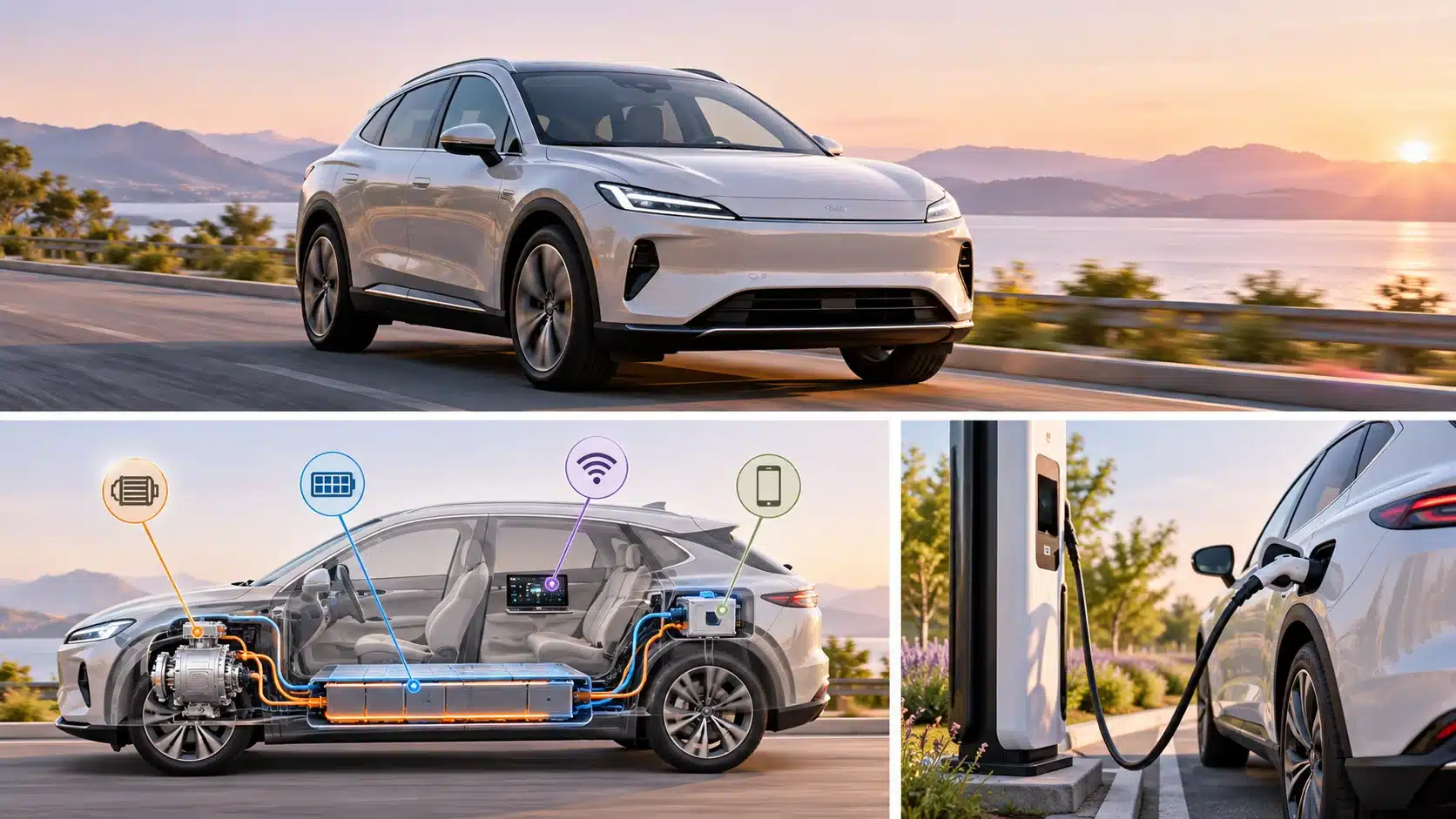
Where Do Electromagnetic Fields Come From in an EV?
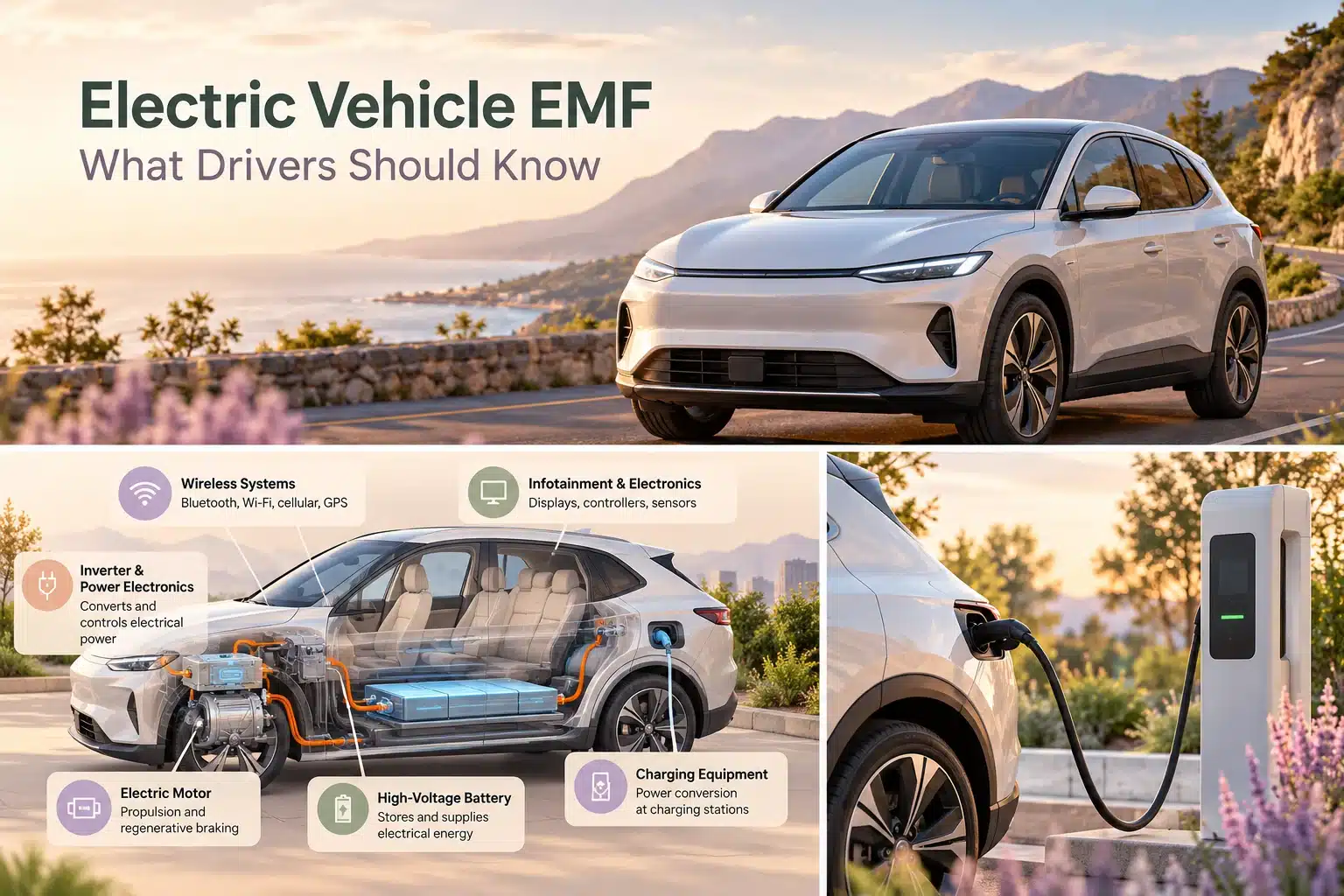
An electric vehicle combines high-power electrical propulsion with many of the electronic and wireless systems already found in modern gasoline vehicles.
The electromagnetic environment can therefore come from several different sources.
| Vehicle component | Main reason it can produce EMF |
|---|---|
| High-voltage battery and cabling | Electrical current moves between the battery and propulsion system |
| Inverter and power electronics | Electrical power is rapidly converted and controlled |
| Electric motor | Electrical current and changing magnetic fields are fundamental to motor operation |
| Regenerative braking | Electrical current changes as energy is recovered during deceleration |
| Infotainment and electronic systems | Displays, controllers, wiring, motors, sensors, and other electronics operate throughout the vehicle |
| Bluetooth, Wi-Fi and cellular systems | Wireless communication uses radiofrequency electromagnetic fields |
| Charging equipment | Power conversion and current flow occur while the vehicle is being charged |
The amount and location of measurable EMF can change while a vehicle is accelerating, cruising, braking, charging, or operating accessories.
Vehicle construction also matters. Battery placement, cable routing, shielding, electronic design, seating position, and measurement distance can all influence what a meter detects.
This is one reason a single EMF number cannot accurately describe every electric vehicle.
Do Electric Cars Produce More EMF Than Gasoline Cars?
Not necessarily.
Gasoline and diesel vehicles also contain wiring, alternators, ignition systems, electric motors, computers, wireless systems, infotainment equipment, and many electronic control modules.
Electric vehicles add high-current propulsion equipment such as large traction batteries, inverters, and electric motors, but vehicle type alone does not determine which car will have the highest measured magnetic field at every seat or measurement point.
A 2025 study published in Electronics measured magnetic fields in current electric vehicles, plug-in hybrids, and internal-combustion vehicles using methods based on the IEC 62764-1:2022 vehicle measurement standard.
All of the measured values were below the International Commission on Non-Ionizing Radiation Protection, or ICNIRP, reference levels for public exposure.
In that particular study, the plug-in hybrid produced the highest measured magnetic-field level. The internal-combustion vehicle ranked next, while the electric vehicle produced the lowest maximum level among the three vehicle types tested.
The researchers also found that the location of the highest measurements varied. Electric and plug-in hybrid vehicles showed their highest readings near the rear-seat measurement area, while the combustion vehicle’s maximum occurred near the driver’s dashboard.
The practical lesson is simple: an EV should not automatically be assumed to have more EMF than every gasoline-powered vehicle.
Vehicle design and measurement conditions matter.
For the broader vehicle-focused discussion already on Your Serenity, see Why Modern Cars Need Electromagnetic Field Protection.
What Does Current Research Say About EMF Inside Electric Vehicles?
Research on vehicle EMF has become more standardized and detailed as electric vehicles have become more common.
A January 2026 study published in Measurement evaluated electric and magnetic fields inside electric vehicles during driving and around electric vehicle supply equipment during charging.
The researchers reported that the electric and magnetic fields measured inside the tested EVs during driving were within the applicable ICNIRP and IEEE exposure limits.
A separate 2025 study of different vehicle types similarly found measurements below ICNIRP public reference levels.
These results are consistent with several earlier investigations showing that measurable electromagnetic fields are present in vehicles but generally remain below established reference levels under the conditions studied.
However, that should not be translated into the broader claim that every possible vehicle, charger, seat, driving condition, or exposure scenario has been exhaustively studied.
Research continues.
A review published in September 2026 examined recent EV measurements, biological evidence, and international safety guidelines. The authors noted that most studies report exposure levels within current standards, while also emphasizing that more standardized research is useful for evaluating complex and long-duration exposure patterns specific to electric vehicles.
In other words, the available evidence provides useful reassurance about measured levels, while continued research can improve our understanding of long-term and vehicle-specific exposure.
What Happens to EMF During Acceleration and Regenerative Braking?
The electromagnetic environment inside an EV is not completely static.
Power demand changes as the car operates.
Hard acceleration can increase electrical current flowing between the battery, inverter, and motor. Regenerative braking changes the direction and amount of electrical power moving through parts of the propulsion system as kinetic energy is converted back into electrical energy.
Researchers have consequently measured variations in magnetic fields during acceleration, steady driving, and deceleration.
Some studies have also detected short-duration peaks during operating changes.
That does not by itself indicate a health hazard. It does demonstrate why proper vehicle-EMF research measures several driving conditions rather than taking one reading from a stationary car and treating it as representative of every journey.
What About Bluetooth, Wi-Fi, 5G and Other Wireless Technology?
The propulsion system is only part of the electromagnetic environment inside a modern vehicle.
Many cars now include Bluetooth connections, cellular data, Wi-Fi hotspots, GPS-related communications, connected infotainment systems, wireless phone functions, keyless systems, and multiple personal mobile devices brought into the cabin by passengers.
These technologies can introduce radiofrequency EMF, which is different from the lower-frequency magnetic fields associated with the vehicle’s power system.
Health Canada identifies cell phones, Wi-Fi equipment, smart meters, and 5G technologies as examples of equipment that uses radiofrequency electromagnetic fields.
ICNIRP likewise maintains separate exposure guidelines for radiofrequency EMF and lower-frequency fields.
This is important when evaluating an EV because a measurement or discussion focused only on its battery and motor does not describe every electromagnetic source in the cabin.
It also means that turning off Bluetooth or a Wi-Fi hotspot would affect those wireless sources, but it would not eliminate the electromagnetic fields associated with operating the electric propulsion system.
Is EV Charging an EMF Source?
Yes. Charging equipment carries and converts electrical power, so electromagnetic fields can be measured around charging systems.
But, as with the vehicle itself, the strength of those fields depends on the equipment, power level, design, measurement location, and distance.
Research published in 2025 that modeled exposure around DC charging equipment reported calculated exposure levels below applicable public and occupational limits under the conditions studied.
A different field-measurement study published in January 2026 found that electric-field measurements around the EV charging equipment it tested remained within the relevant limits, while magnetic flux density at certain positions near some charging equipment exceeded a general-public reference threshold.
These findings are not necessarily contradictory. They involved different equipment, methods, locations, and exposure conditions.
They demonstrate why statements such as “all EV chargers are harmless” or “EV chargers produce dangerous radiation” are both too simplistic.
For everyday use, drivers should follow the charging equipment manufacturer’s instructions and normal operating procedures rather than relying on alarmist claims circulating online.
Are Electric Vehicle EMFs Harmful?
The most accurate answer is that electric vehicles produce measurable electromagnetic fields, but current measurements generally fall below established international exposure guidelines under the conditions studied.
ICNIRP develops guidelines for lower-frequency electromagnetic fields, while its separate radiofrequency guidance covers wireless-frequency exposures. These guidelines are intended to protect people against established adverse effects at the relevant frequencies.
Health Canada similarly provides public guidance on electric and magnetic fields and explains that field strength generally decreases with distance from the source.
In the United States, the National Institute of Environmental Health Sciences explains that electric and magnetic fields are forms of non-ionizing energy and summarizes ongoing research into their possible health implications.
The newer EV-specific research adds another layer to that picture. Measurements have generally been reassuring relative to established exposure limits, but researchers continue to investigate long-term use, different vehicle architectures, charging technologies, and exposure variability.
That is a more defensible conclusion than either ignoring EMF completely or treating every detectable field as proof of danger.
Can You Reduce EMF Exposure Inside a Car?
People who prefer to take a precautionary approach can begin with simple, practical decisions rather than fear-based measures.
Unnecessary wireless functions can be switched off when they are not needed. A phone does not need to remain pressed against the body simply because it is being used for navigation or audio. Drivers can also avoid spending unnecessary time immediately beside charging equipment after a charging session has begun.
These steps should be kept in perspective. Modern vehicles contain many electrical and wireless systems, and eliminating every electromagnetic field from a functioning car is neither practical nor necessary under current exposure guidance.
Distance is also relevant. Public-health resources note that electromagnetic field strength typically declines as distance from a source increases.
The goal should be informed technology use, not anxiety about every electronic component in the vehicle.
Where Does MemonizerCAR Fit Into the Discussion?
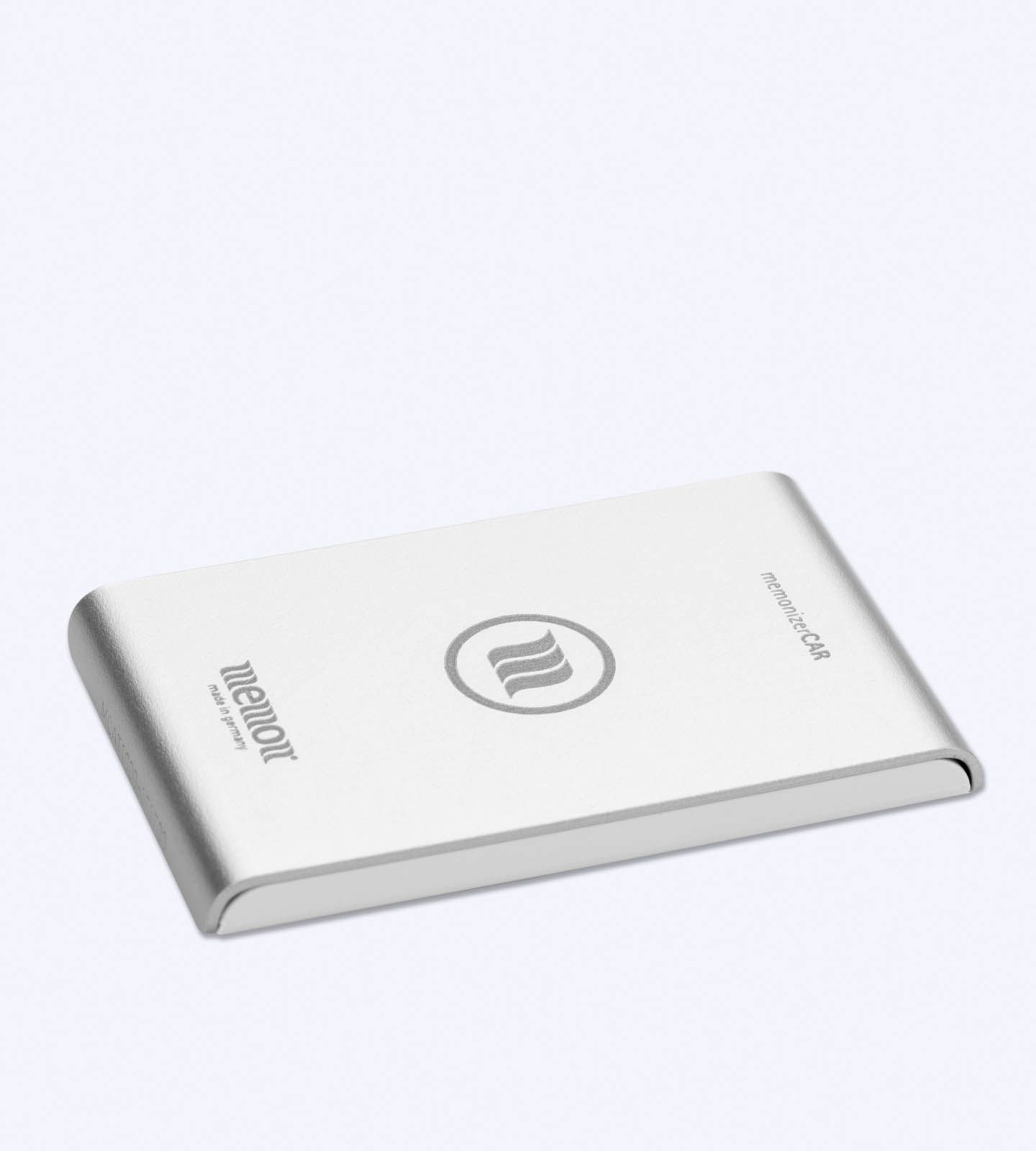
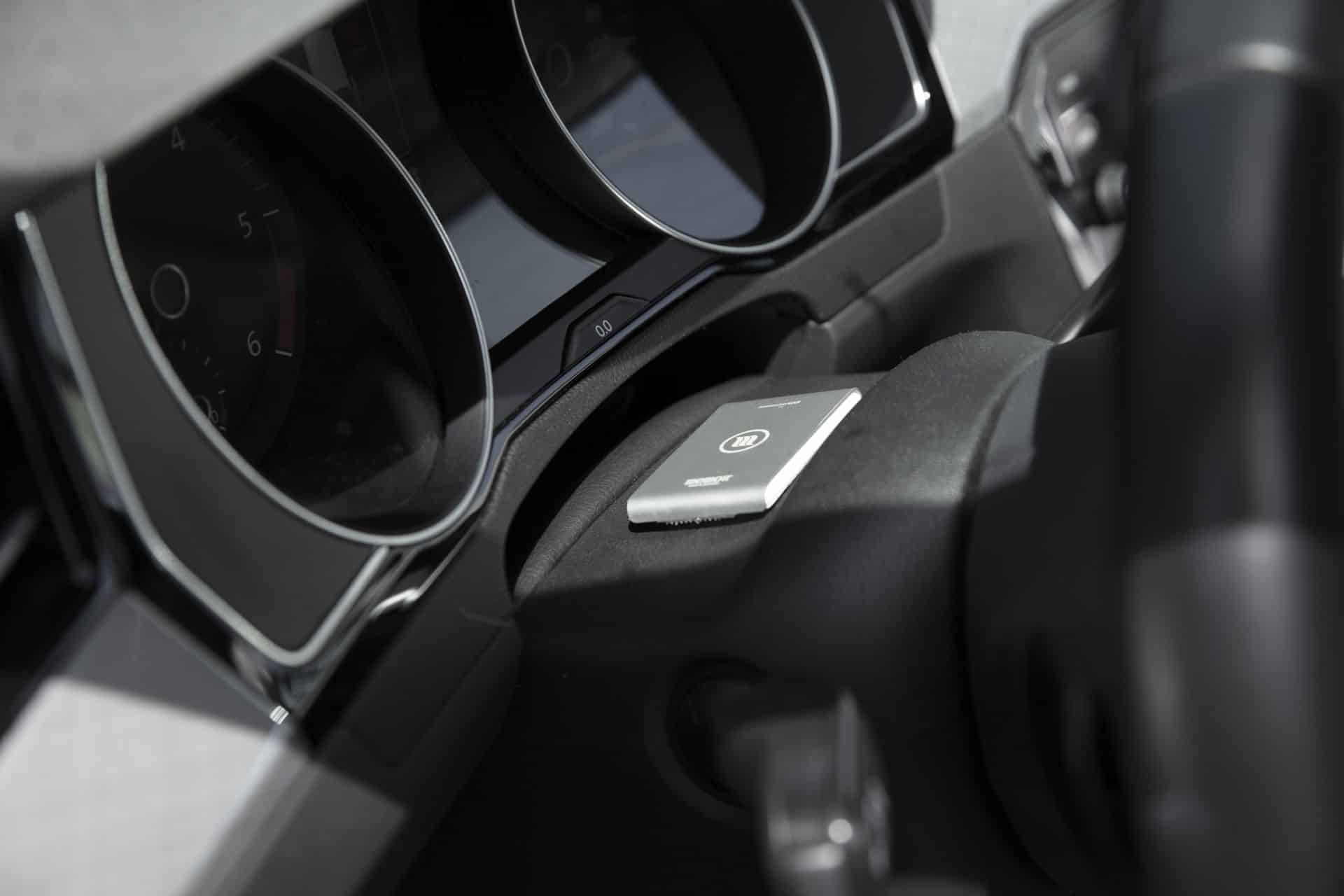
For customers who are already exploring Memon products for a vehicle environment, Your Serenity offers MemonizerCAR for compatible cars, electric vehicles, motorcycles, and similar vehicle applications.
Memon describes its vehicle technology as a bioenergetic product intended for electromagnetic or “electrosmog” environments. These are manufacturer descriptions and should be distinguished from established scientific evidence.
MemonizerCAR should not be presented as a medical treatment or as proof that ordinary EV exposure is harmful.
Customers interested in the product should instead review its intended application, vehicle compatibility, size, installation guidance, and current product information before ordering.
Your Serenity can provide product-selection guidance for customers comparing available Memon vehicle options. You can also browse the current Memon product collection.
Electric Vehicle EMF: The Bottom Line
Electric vehicles do produce electromagnetic fields.
Those fields can come from the battery and power cabling, inverter, motor, regenerative braking system, electronics, wireless communications, and charging equipment.
But the presence of a measurable electromagnetic field does not by itself establish a health hazard.
Recent vehicle measurements generally show in-cabin levels below international public-exposure reference levels, and electric vehicles do not consistently produce higher magnetic fields than conventional vehicles in every comparison.
Research is continuing, particularly around long-term exposure, different vehicle designs, rapidly changing electrical loads, and newer charging technologies.
For drivers, the most useful approach is to understand the different sources, follow credible research rather than fear-based claims, use wireless technology thoughtfully, and evaluate products based on accurate information about what they are actually designed to do.
If you would like help determining whether MemonizerCAR is compatible with your vehicle, review the MemonizerCAR product information or contact Your Serenity for product-selection guidance.
Frequently Asked Questions
Do electric vehicles emit electromagnetic radiation?
Electric vehicles produce electric and magnetic fields as part of normal operation. Their wireless systems can also produce radiofrequency electromagnetic fields. These are forms of non-ionizing electromagnetic energy and are different from ionizing radiation such as X-rays.
Are EVs higher in EMF than gasoline cars?
Not always. Modern gasoline vehicles also contain many electrical and wireless components. A 2025 vehicle study found all tested EV, plug-in hybrid, and combustion-vehicle measurements below ICNIRP public reference levels, with the plug-in hybrid producing the highest maximum measurement and the EV the lowest among the vehicles evaluated.
Where is EMF generated in an electric car?
Potential sources include high-voltage cabling, the traction battery system, inverter, electric motor, regenerative braking system, vehicle electronics, wireless communications, and charging equipment.
Does charging an electric vehicle create EMF?
Yes. Electrical current and power-conversion equipment create measurable electric and magnetic fields during charging. Measurements vary depending on the charger, power level, design, location, and distance.
Is EV EMF the same as X-ray radiation?
No. The electromagnetic fields associated with vehicle electrical systems and wireless communication are non-ionizing. X-rays are ionizing radiation and have very different physical properties.
Is MemonizerCAR specifically intended for electric vehicles?
Your Serenity lists MemonizerCAR for compatible cars and electric vehicles. Review the current product specifications and installation guidance before selecting a model.
About Your Serenity
Your Serenity provides Memon product information and ordering support for customers seeking practical guidance on product selection, installation, and ownership. Browse the Memon product range or contact the team for product-selection guidance.
Transparency note: Your Serenity sells Memon products. Scientific statements in this article are separated from manufacturer product descriptions, and the article is intended for general educational purposes. Product information is not medical advice, diagnosis, or treatment.